Reposition Drugs. De-Risk Trials.
Powered by Multi-Omics AI.
We model patient biology across multiple molecular layers to identify which existing compounds work for which biological subtypes—and design the experiments that prove it. Our initial focus is autism spectrum disorder.
What We Do
Conditions like autism affect every patient differently, which is why the same therapy succeeds in one person and fails in another. We measure multiple layers of biology—gut microbiome, metabolism, proteins, and genetics—to build a complete molecular picture of each patient, then use AI to resolve heterogeneous populations into well-defined biological subtypes.
That resolution powers two things partners can act on: finding which existing drugs are likely to work for which subtype, and designing the trials and biomarker panels that prove it.
- Drug repositioning: Surface existing, already-de-risked compounds likely to work for specific biological subtypes—giving partners a faster, lower-risk path to the clinic
- Experimental design: Stratify trial cohorts and select biomarkers to maximize signal and statistical power before you spend on a trial
- Complete molecular picture: Multiple biological systems modeled together over time, not a single snapshot in isolation
Digital Twins: A Model of Each Patient
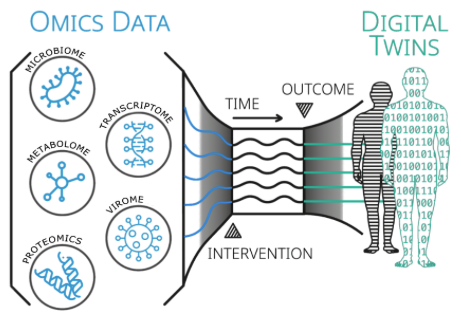
Think of a digital twin like a weather forecast, but for human biology. Just as meteorologists combine temperature, pressure, humidity, and wind data to predict tomorrow's weather, we combine data from the gut microbiome, metabolism, proteins, and genes to model how a patient's biology works.
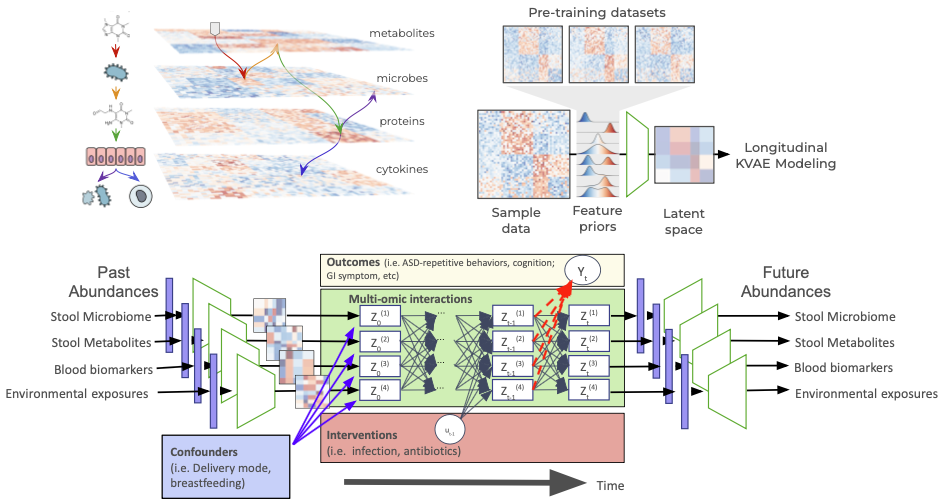
Most approaches take a single snapshot of one biological system. We track multiple systems over time. This matters because biology isn't static—it's constantly changing. By learning these patterns, our AI can predict how a patient will respond to a given intervention before it's administered, which is precisely what's needed to prioritize compounds and enrich trial cohorts.
This is powered by a type of AI specifically designed to learn how complex systems change over time. Where standard AI sees a still photo, our platform sees the whole movie—capturing how biological systems interact and evolve together.
Why This Approach Is Different
Most biomarker approaches look at one layer—genomics, or the microbiome, or a single assay. Each gives a partial view. We integrate them, and the result isn't just additive—it's exponentially more accurate at separating responders from non-responders.
- Multiple biological layers, not just one: Gut microbiome, metabolites, proteins, and genetics analyzed together reveal patterns no single test can detect
- Changes over time, not just a snapshot: Our AI models how your biology evolves, which is critical for predicting what will help
- Causes, not just correlations: Most AI finds patterns that appear together. Our platform identifies which biological factors are actually driving symptoms—and what happens when you change them. This is what makes our predictions actionable
- Purpose-built technology: To make this possible, we built a new programming language from the ground up—designed specifically for constructing AI models that reason about cause-and-effect under uncertainty. This lets us coordinate specialized models across each type of biological data into a single, coherent picture
- Backed by published science: Our methodology has been validated in Nature Neuroscience, Nature Methods, and Nature Communications, and trained on over 1 million curated biological samples

Core Modeling Team for Wellcome LEAP FORM
We are the core computational modeling team for Wellcome LEAP's FORM program (Foundations of a Resilient Microbiome)—a $50 million global initiative investigating the link between the gut microbiome and neurodevelopment in early life.
As part of this consortium, we are analyzing multi-omics data from 17,000 individuals across multiple longitudinal birth cohorts, working alongside world-leading research institutions to determine whether early-life microbiome dysfunction is causally linked to neurodevelopmental outcomes including autism.
Trusted By Leading Research Institutions



















Partner With Us
We work with pharmaceutical teams and research consortia to reposition assets, stratify patients, and design trials that succeed. Get in touch to discuss your program.
Contact Us